From the archives: ‘DeafGeoff’ in The Post-Standard, 2006

From The Post-Standard archives: Feb. 27, 2006, by William LaRue

‘DEAF GEOFF’
HOT 107.9 SIDEKICK EMBRACES HIS HEARING LOSS, AND SO DO HIS FANS
deafgeoff_2006

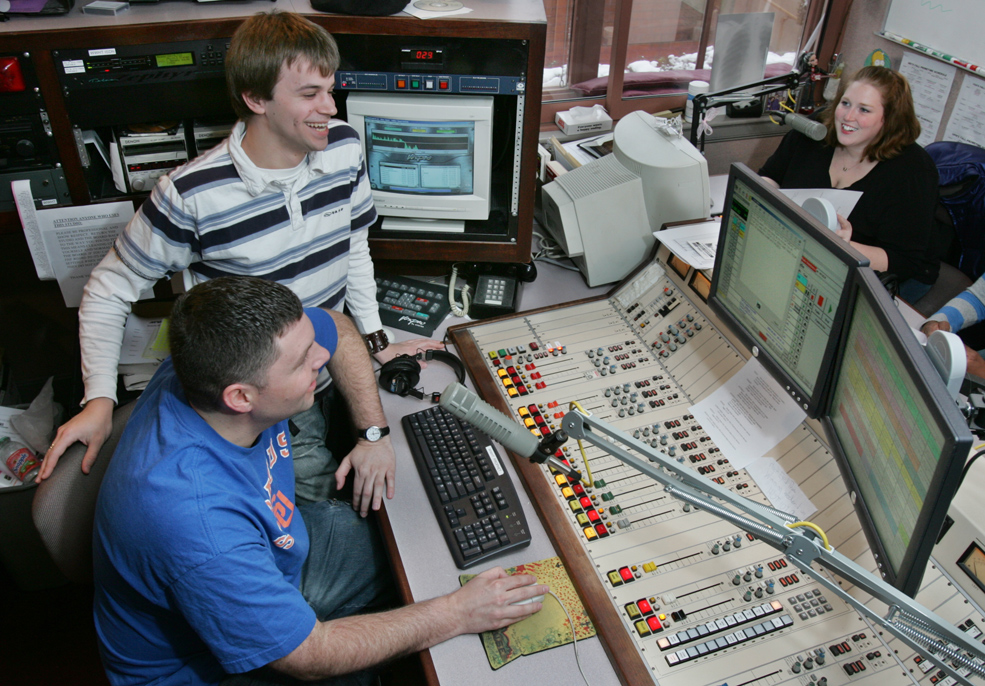
WWHT-FM (Hot 107.9) morning producer Geoff Herbert has trouble taking calls from listeners. Sometimes, he misunderstands what hosts Marty and Shannon are saying to him.

“Recently, Marty said something about Duke University and I thought he said something about Jewish people, ” Herbert says. “Sometimes, it’s so off-base, it’s funny.”

Even if he didn’t call himself “DeafGeoff” on the air, there would be little doubt that Herbert is bringing something quite exceptional to Syracuse morning radio.

Herbert, 21, was born with a hearing loss so severe that music often sounds to him like his head is under water. Some notes he can’t hear at all.

And yet, despite a speech impediment caused by his severe hearing loss, he is finding early success in a broadcast profession that usually values people with a good ear for hit songs or with a clear voice for announcing.

Herbert has become a listener favorite on the Top-40 station’s morning show, where he regularly joins the hosts in on-air banter and comedy bits. The station in the fall gave away 250 copies of a Christmas album, “Deaf the Halls, ” in which Herbert sang holiday tunes, including off-key versions of “Do You Hear What I Hear” and “Silent Night.”

Allowing the hearing-loss humor to flow easily on the morning show is something Herbert says he encourages.

That, plus asking people to call him “DeafGeoff, ” are his ways to let others know he embraces his hearing loss and wants others to do the same.

“It’s a good characterization of who I am. My name is Geoff and I’m partially deaf, ” Herbert says. “Of course, with the disability, being hearing-impaired, the least likely job is probably radio. But that’s one of the things I love about it. It excites me to be able to do something people don’t expect. And if I can do it well, people can kind of go, “Wow!”‘

He also embraces the local fame that goes with it.

A few weeks ago, at the drive-up window of a fast-food restaurant, some employees inside recognized his voice.

“They were like, “Are you DeafGeoff?’ And they go, “Ah, man, I love the show. You’re so awesome. You’re so funny, “‘ Herbert says. “I’ve even been asked for my autograph.”

Technically diagnosed as “hard of hearing, ” Herbert says, he was born with the ability to pick up only about 10 percent of what an average person hears. He uses lip-reading, two hearing aids and an eye for visual cues to understand most of the time what people are saying, although over the phone he often has to ask callers to repeat themselves.

Herbert began working at Hot 107.9 two years ago as an intern while he was studying communications at Syracuse University.

He performed so well as a volunteer that he was hired in fall 2004 to become Hot’s morning producer. It’s a job that involves getting to the station by 5 a.m. to edit audio clips and coordinate that day’s music, comedy bits, contests, games and other content.

On a recent Tuesday morning, shortly after 8:30, Herbert is carrying on a long chat about TV with Marty, who, like Shannon, doesn’t reveal his last name publicly.

Marty asks Herbert if he heard about “American Idol” auditions in Boston last summer, hinting that he should have considered trying out for the Fox talent series.

Herbert tells Marty he “heard about it plenty.” Then he adds, “Let’s be honest. My singing was not going to get me very far.” They both laugh.

Marty and Shannon often make references to his hearing loss, Herbert says, although they draw the line at doing anything smacking of ridicule.

When one listener called up to ask why the show didn’t “just get that retarded guy off the air, ” Herbert says, Marty and Shannon quickly “ripped into him.”

“They are very protective, ” Herbert says with a smile.

Interviewed off the air, Marty says Herbert is a talented morning producer who does his job well.

“I think it’s cool he puts his disability aside and says, “I’m going to do this, ‘ instead of being embarrassed by it, ” Marty says.

In addition to his part-time job at Hot, Herbert works nights and weekends at a Blockbuster video store, and is also a disc jockey for private parties and dances.

Herbert, who grew up in Acton, Mass., was manager of his high school radio station for 2 years. He was also general manager at WJPZ-FM (Z89), the student station at SU, where he already has met requirements to graduate in May with a bachelor’s degree in radio, television and film.

He says his dream is to eventually get a job in radio in Boston or another big city.

For what he has done already, Herbert can be seen as an inspiration, especially by young people with a disability who worry some occupations are closed to them, says Anne Costa, director of communications for Aurora of Central New York, an organization that serves people with hearing and visual impairments.

Although he’s a rarity, Herbert isn’t the only one with hearing loss working in Syracuse radio. Aurora in November presented an excellence award to WVOA-FM and WSIV-AM general manager Jim Wall, 68, who still does occasional on-air work, despite losing most of his hearing in the mid-1980s due to disease.

“I would certainly congratulate the young man, ” Wall says when asked about Herbert. “I encourage him 100 percent.”

Costa says Herbert probably has strong support in the deaf community, although she says some might be offended if they thought on-air bits were making fun of him for his hearing loss.

Herbert says some aspects of living with his disability are funny. He says he’s not afraid to share this or to show that, like anyone else, he excels at some things and struggles with others.

“I want to let people know my hearing disability is part of who I am. I’m comfortable with it and you should be as well, ” he says.

Note: This article appeared in The Post-Standard in 2006, years before Herbert started working at the Syracuse newspaper.

Lipreading Syracuse basketball’s Jim Boeheim: My first feature article in The Post-Standard

Lipreading Jim Boeheim

A sneak preview of Geoff Herbert’s first feature article in The Post-Standard, appearing in print on Sunday, February 10, 2013.

“Wanna see my picture on the cover, wanna buy five copies for my mother…”

I recently began my new position as Entertainment Reporter at Syracuse Media Group, the new home of syracuse.com and The Post-Standard newspaper. I mainly focus on writing about hot topics that can include movies, music, television, celebrity gossip, technology news and Central New York life. On Friday, I wrote about something a little different that people have asked about many times so it seemed fitting to share:

#Lipreading Jim Boeheim: How Syracuse basketball gets even more fun on Twitter.”

While everything I write appears online at syracuse.com, I’m excited to say that the piece will also be appearing in print on Sunday, Feb. 10 — my first feature article in The Post-Standard!

I’ll be buying a few copies for family members (Look, mom! I have a job!) but I also recommend picking up one for yourself if you live in Central New York. Not only does it include great photos of the SU coach making his priceless facial expressions, but it’s also a lot better than the first two articles I wrote on syracuse.com in 2010 when I started as an Associate Producer.

Thank you to all for reading and supporting me, and a big thank you to my hundreds of new followers. I’m excited to share with you more lipreading tweets from upcoming Syracuse basketball games as well as stories, news and observations in 140 characters (or less). Let’s go Orange!

Video: Geoff ‘DeafGeoff’ Herbert speaks at TEDxBuffalo about hearing loss, listening

Geoff 'DeafGeoff' Herbert at TEDxBuffalo

Geoff “DeafGeoff” Herbert speaks at TEDxBuffalo in October 2012 about being a deaf DJ, growing up with hearing loss, and the importance of listening versus hearing.


I spoke at my first TED (Technology, Entertainment, Design) event on October 9th at Canisius College in Buffalo, and I’m happy to share with you the final video cut (in HD! See my face for radio in crisp pictures!) from my TEDxBuffalo speech titled “Listening is More Important Than Hearing.”

As an adult who was born with a profound binaural hearing loss, I was happy to share my experiences growing up hard-of-hearing and how I pursued the careers that I’ve succeeded in, including more than 10 years as a DJ (including six years as a morning show producer at a Clear Channel radio station in Syracuse, perhaps as the only deaf on-air personality in the country). I talked about speech therapy, my love of music, and the importance of listening versus hearing.

I’m now an Entertainment Reporter for Syracuse Media Group, the home of syracuse.com and The Post-Standard newspaper, but also still work as a disc jockey for parties, dances, weddings and other events. I still embrace and advocate the value of listening because I still do the same thing at my job — listening to what the audience wants, responding to them and continuing to inform and entertain.

Thank you again to Kevin Purdy for inviting me to speak at TEDxBuffalo and much appreciation to all who attended, watched and/or tweeted me their thoughts afterwards. It was a fun experience and I’m always happy to share my experiences. If you have any follow-up questions or would like to know more, please feel free to contact me.

Watch: Geoff ‘DeafGeoff’ Herbert speaks at TEDxBuffalo about being a deaf DJ

Geoff 'DeafGeoff' Herbert talks at TEDxBuffalo on Oct. 9, 2012

Geoff ‘DeafGeoff’ Herbert talks at TEDxBuffalo on Oct. 9, 2012 about being a deaf DJ and the importance of listening over hearing.

I was humbled and honored to be invited to speak at TEDxBuffalo, my first TED (Technology, Entertainment, Design) event, about being a deaf DJ and the challenges I’ve faced in my life growing up mostly deaf. The event was held Tuesday, October 9, at Canisius College in Buffalo to an invite-only crowd and was also live-streamed online and recorded for future events.

In a speech titled “Listening Is More Important Than Hearing,” I shared how I was born with a profound binaural hearing loss and learned how to communicate through years of speech therapy. I demonstrated some of the challenges that come from lipreading, such as how “V” and “F” look identical but the sound is different by how much air comes out of your mouth and whether your voice box vibrates when saying it. I then talked about falling in love with music, and its transformative power that led me to pursuing a career in radio — and never once letting my “disability” stand in the way. I learned to appreciate music by listening to it, not just hearing it, and worked hard at radio stations in high school and college before landing a job at Clear Channel’s HOT 107.9 in Syracuse as a morning show producer and sidekick known as “DeafGeoff.” I worked with “Marty & Shannon in the Morning” for six years as possibly the only mostly deaf on-air personality in the country and our show was rated No. 1 in its target 18-34 demographic.

I’m now a producer/entertainment reporter at syracuse.com, the online affiliate of The Post-Standard newspaper but the challenges I face today are the same. At a radio station disc jockey (or as a club DJ), you have to listen to what your audience wants and respond to it. Social media users and website readers will often comment and/or share stories, and it’s the same thing — listening to the audience, responding to them, and continuing to inform and/or entertain.

I’m also still a DJ for parties, dances, weddings, events, etc. and I’m constantly listening to music and studying it, watching audiences to see how they react to songs. It’s amazing how hearing a favorite tune can change a person’s mood — or force them to start moonwalking (or shuffling or Gangnam-Styling or whatever) because the music is that infectious.

You can watch video of me speaking at TEDxBuffalo here, but please check out the other speakers as well. All had great, unique thoughts to bring to the event and I was happy to be a part of it.

Thank you to all who watched and tweeted me their thoughts afterwards, and thank you to Kevin Purdy for inviting me to speak at TEDxBuffalo. If anyone has any follow-up questions or would like to know more, please feel free to email me.

Lipreading and live-tweeting: Bring something unique to Twitter during events

Lipreading: Examples of sounds and what mouths look like when saying them

Lipreading: Examples of sounds and what mouths look like when saying them

Twitter is an increasingly fun way to watch live events on TV. By following live-tweets with a #hashtag, you can be watching alone in your pajamas but feel like you’re at a party with thousands of fellow fans who are making interesting observations and comments.

That being said, there’s an important rule for live-tweeting any event — if it’s on TV and being watched by millions, DO NOT TWEET A PLAY-BY-PLAY. Posting “I can’t believe she won that award!” or “And Otis Spunkmeyer passes it to Scrooge McDuck, who scores and puts the Lone Rangers on top” serves no value to a nationally televised event considering other people can watch the same thing — its redundant and annoying. Use Twitter to add a third dimension to the game or show by posting original content or unique reactions.

With that in mind, I started live-tweeting Syracuse University basketball games with #lipreading tweets of what players and coaches, especially Jim Boeheim, are saying when the TV shows close-ups of their faces. Since there’s no audio from them in those shots, I’m adding an extra element to the game that viewers who aren’t deaf and hard-of-hearing likely can’t follow.

I got the idea for specifically focusing on tweeting lipreading (or lip reading, speechreading) from a German deaf woman, Julia Probst, who reads the lips of soccer players and coaches during matches and tweets them, providing fans with a running dialogue that they would otherwise not be privy to. It’s made me enjoy sports more and I hope to continue it with Orange football this fall and other teams I’m a fan of, like the Boston Celtics, New England Patriots and the Boston Red Sox.

Some examples of lipreading live-tweets I’ve posted:

  • #Lipreading Jim Boeheim: “That’s a flagrant…” after Rutgers fouled Dion Waiters #GoOrange #BeatRutgers
  • #Lipreading Jim Boeheim: “Are you kidding me? … [not nice words] Come on, Brandon!” #GoOrange #BeatWVU
  • CJ Fair clearly said “F***, man” after he was fouled. He looks WAY too young for that kind of language. #lipreading #babyface
  • #Lipreading Jim Boeheim: “Listen. LISTEN! You can’t be fouling like that…” to SU’s Rakeem Christmas #GoOrange #BeatWVU.

Everyone can lipread a little bit, whether they realize it or not — being hard-of-hearing, I did speech therapy as a kid so I could understand speech (as well as speak it better). Lipreading is simply the visual interpretation of the movements of the lips, face and tongue. Without hearing aids, I’m 90% deaf but with lipreading, context and residual hearing I can follow conversations pretty well most of the time.

If you can’t lipread, don’t feel bad — just add something different when live-tweeting an event. Give people a reason to follow you on Twitter.

A few additional notes on lipreading or speechreading:

  • So many sounds and shapes look exactly the same, which means only about 30 to 40 percent of speech is accurately visible. “Get the mail” and “Catch the pail” look very similar, for example, and obviously have completely different meanings. Oftentimes, lipreading is only accurate with context (such as listening with hearing aids) and/or visual cues. For example, if a basketball player just made a bad play, you know the coach is more likely to say “That was stupid, don’t do that” than “Taco soup is delicious.”
  • When communicating with a deaf/HOH person, face them and speak clearly and naturally. People change the way they talk all the time — resting your chin on your hand affects speech, as does gum, mustaches, tongue-piercings, talking out of the side of your mouth, etc. Also, when people talk faster or slower it makes it harder to lipread and, when people yell, their mouths get wider and it becomes very difficult to see what they are saying. (Translation: Shouting at deaf people doesn’t help them understand you.) It’s very difficult to read lips on a person’s face/mouth that’s constantly moving or is facing in another direction, too.
  • While many references to hard-of-hearing in comedy lean offensive (i.e. the basketball coach near the beginning of “Van Wilder”) lipreading can be very funny. Marlee Matlin, the only deaf actress to win the Academy Award for Best Actress, starred in a “Seinfeld” episode as a tennis lineswoman who dates Jerry and helps George lipread another woman’s conversation from across the room while Kramer interprets for her in sign language. She thought they said “Let’s sleep together” when they said “Let’s sweep together” — which actually isn’t a likely mistake for a deaf person to make as “sw” and “sl” form very different mouth shapes, but was still a funny example of how a subtle misinterpretation can change an entire conversation’s meaning. For more outrageous (though unlikely) lipreading mistakes, check out “Bad Lip Reading.”

Acton, Massachusetts: Fun facts about my hometown

Acton, Massachusetts: The hometown of Steve Carell, Big Bird, and DeafGeoff.

Acton, Massachusetts: Home of Steve Carell, Big Bird, and DeafGeoff.

Though I was born in California (my excuse for wearing Pacific Sunwear clothing all through my teen years), I grew up in Acton, Massachusetts, a small suburb of Boston. I went to school there for my K-12 years before leaving to attend Syracuse University and staying in the Central New York city after graduation. Although most acquaintances from those years living in Acton I only keep in touch with via Facebook (don’t we all?) I still go back several times a year to see family and my closest friends. So I thought it might be fun to share some fun facts about my hometown.

  • Acton is 21 miles west/northwest of Boston and 10 miles from Lowell, in Middlesex County. The town is essentially divided into five parts: North Acton, West Acton, Acton Center, East Acton, and South Acton.
  • The hilarious Steve Carell, perhaps best known for his role as Michael Scott on “The Office,” grew up in South Acton. He attended private school in the bordering town of Concord, MA, but his childhood home is just a stone’s throw away from mine. The “40-Year-Old Virgin” star told New York Magazine that the hardest, oddest job he ever had before making it big was sorting mail in Acton and then going out on a route as a rural mail carrier.
  • Acton-Boxborough Regional High School’s sports teams are known as “the Colonials.”
  • Tom Barrasso, who played goalie for the Colonials in the early ’80s, went straight from A-B High School to play in the NHL, skipping college. He won back-to-back Stanley Cups in 1991 and 1992 with the Pittsburgh Penguins.
  • The ABRHS football team won the Eastern Massachusetts Division 2 state championships four years in a row, from 2001 to 2004. They also had a 52-game winning streak during that period.
  • The first American to die in the Revolutionary War was from Acton. Captain Isaac Davis died leading Acton’s Minutemen at the Battle of Concord & Lexington, the first conflict of the American Revolution between the Colonists and the British, on April 19, 1775. Actors re-enact the battle every year on the anniversary.
  • The anniversary, observed on the third Monday of every April, is known as Patriots Day. No other state in the union celebrates it, but Massachusetts (and Maine) takes the day off to remember the beginning of its escape from England’s tyranny (as the U.S. History teachers love to describe it). They also use the holiday to watch the Boston Marathon.
  • Caroll Spinney, the puppeteer who created “Sesame Street” characters Big Bird and Oscar the Grouch, is from Acton. I met him at a signing for his book “The Wisdom of Big Bird” once. Sweet guy.
  • The town is 20 square miles and has a little more than 20,000 residents despite a huge chunk of it being forests or conservation lands (Acton Arboretum, Nagog Hill, Nashoba Brook, etc).
  • My favorite meal of all time is in Acton at a pizza-and-sub shop called T.C. Lando’s — they make a sandwich/torpedo/hoagie called a “Budster” (first photo on this page) which consists of chicken fingers, bacon, BBQ sauce and cheese in a sub. Delicious, and I have yet to find any other place that can make the same combination as tasty.
  • Acton was named the 16th Best Place To Live among small towns in the country by Money Magazine in 2009 and in 2011.

Acton. It’s a pretty nice place. Stop by sometime.

Tell them Large Marge Geoff “DeafGeoff” Herbert sent you.

Deaf The Halls: DeafGeoff’s hilarious album of Christmas songs and holiday parodies, revisited

Deaf The Halls, DeafGeoff's holiday parody album

'Deaf The Halls' is a holiday album featuring Christmas and Hanukkah songs, plus parodies sung and rapped (badly) by DeafGeoff. Be careful when listening in the car, you may drive off the road laughing.


In my radio days at HOT 107.9, I recorded songs as DeafGeoff on my own holiday albums called “Deaf The Halls.” I sang and rapped so badly that everyone seemed to get a kick out of it (and I enjoyed having fun with it), so I couldn’t resist doing it for four years straight. I did my own versions of some Christmas classics, a couple tunes for the Hanukkah crowd, and even wrote a few parodies of popular songs by Kanye West, Mystikal, and Bing Crosby. I put together a sort of “greatest hits” in 2008, and for those that would like to hear it again — or have never heard it! — here’s the track listing, a free .zip download of the mp3 files, and four music videos from Deaf The Halls. Enjoy!

Deaf The Halls: The Deaf-initive Collection
1. Toy Lockdown (parody of Kanye West’s “Love Lockdown”)
2. Deaf The Halls, Part 1
3. Deaf In A Box
4. Rudolph The Red-Nosed Reindeer
5. Party Like Santa Claus (parody of Shop Boyz’ “Party Like A Rock Star”)
6. Rockin’ Around The Christmas Tree
7. I Have A Little Dreidel
8. Ho Ho Ho f/ Marty & Sugarcane Chris (parody of Hurricane Chris’ “A Bay Bay”)
9. Jingle Bell Rock
10. Deaf The Halls, Part Deux (parody of Mystikal’s “Shake Ya Ass”)
11. The Chipmunk Song f/ Marty & Shannon
12. Deaf Christmas
13. Santa Baby
14. Do You Hear What I Hear?
15. Cholla At Ya Boy (Happy Chanukah) f/ Jus Mic
16. Baby It’s Cold Outside w/ Marty the One Man Party
17. The Christmas Song
18. Last Christmas
19. Silent Night
20. Auld Lang Syne

» Click here to download the “Deaf The Halls” collection in mp3 format [.zip file]

Deaf The Halls, the music videos:


Merry Chrismukkah and Happy Festivus (for the rest of us)!

Harder, Better, (slightly) Fatter, Stronger: One year after I broke my leg in roller derby

Funk Roll Brother, my roller derby alter ego, a few months before breaking my leg.

On October 16, 2010, I broke my leg playing men’s roller derby. I shattered my fibula and broke my tibia, the only two bones that connect the knee to the foot. After two surgeries, I now have a metal rod in my right leg, plus a plate on my ankle and a dozen screws holding it all together (see: x-ray photos).

A year later, I’m harder, better, (slightly) fatter and stronger.

Harder: With my new bionic leg, the doctor told me I was virtually indestructible. It should be harder to break my leg than ever. Kind of like the movie Kick-Ass, only I’m certainly not about to dress up like a superhero and run around fighting crime. “Virtually” is not the same as “completely.” Plus, spandex? Ew.

Better: I’m about 98% recovered. I can walk normal, go up and down the stairs, dance, skip, even run a little bit. My knee is the only thing still holding me back sometimes, as the joint still hurts if I push it too hard — so I try and stick with non-impact cardio whenever possible, but I’ve done a few kickball games this summer and I’ll sprint through the rain to my car. I’m almost all better.

Fatter: Since I broke my leg, I’ve gained about 10-15 pounds. I was on a couch for two months, recovering, but that’s not much excuse 10 months later. My diet isn’t great (but it never has been) and my job is pretty sedentary; still, I really just need to motivate myself to exercise more. I’m not going back to roller derby, but that wouldn’t help much anyway — the sport’s fun, but it doesn’t really do a whole lot for fat burning. Suzy Hotrod didn’t get her body from just roller skating around, folks.

Stronger: Not being able to use my leg for two months, I built up upper body strength. Using crutches, I was forced to use my arms more for everything. I don’t have tickets to the gun show or anything, but I can carry my DJ equipment more easily than I used to.

In the rest of my life, I’m still doing the same things I enjoy doing — music, going to concerts, socializing, writing, movies, etc. The only thing I have yet to attempt with my new bionic leg is airport security. I haven’t flown anywhere since the injury, and I’d be curious to see if I set off the metal detectors. The doctor told me it wouldn’t, but we’ll just have to see…

Remembering 9/11: Am I the only person who read what happened first, before watching?

On September 11, 2001, I was 17 years old and working in my high school radio station. I was the general manager of WHAB, a 10-watt station heard in a mile-radius on 89.1 FM in Acton, Massachusetts. That morning, I was working in the station during one of my free periods, gathering news for us to include in our broadcasts throughout the day. We had a continuous paper feed from the Associated Press that came out on a dot matrix printer, an old model that printed paper with holes on both sides, and all the pages were attached with perforations.

At 8:46 a.m., when American Airlines Flight 11 hit the World Trade Center’s North Tower, I was alone in the station with no television or Internet. The only computer in the studio was used primarily for audio editing. Sponsorship identifications were printed on index cards, and daily news reports were either hand-written or literally cut-and-pasted from the AP news feed.

Around 8:50 a.m. a one-sentence “breaking news” blurb said a plane had collided with one of the twin towers in New York City, believed to be an accident — no mention of terrorists, victims or anything that would indicate what would come next. It wasn’t a local news story (Acton is a suburb of Boston, about 25 miles west) but I thought it was at least significant enough to include in the morning’s first newscasts. (At the time, the student-run station was only on the air from 9:30 a.m. to 5:30 p.m.) So I cut. And pasted. I’m not even sure if I had chosen it to be the lead story.

Someone then walked by and waved at me, indicating that I should follow them to the A/V room. We joined a small huddle of people staring at a TV showing a live news feed of the World Trade Center. It was now 9:03 a.m. and we all witnessed, live on television, United Airlines Flight 175 crashing into the South Tower. Everyone reacted with horror and disbelief — two planes was clearly not an accident. Many began panicking, worrying if they knew anyone working in the towers at the time.

The rest of the school day was a blur as teachers played the role of counselors instead of sticking to lesson plans. As the facts developed, and two more hijacked planes crashed — Flight 93 in Shanksville, PA and Flight 77 into the Pentagon — September 11th quickly became a day we would never forget. My peers lost whatever innocence they had left as we all realized that the world is a dangerous place and no one is ever truly safe.

While the previous generation recalls exactly where they were when John F. Kennedy was shot, 9/11 became our shared moment in grief and we will always remember where we were and what we were doing that day.

I was alone in a radio station with a stack of printer paper. Was I the only person who read what happened first, before watching?

Today, on the tenth anniversary of the September 11 attacks, I pause to remember the many lives we lost that day and the countless volunteers and respondents who did everything possible to help. We will never forget.

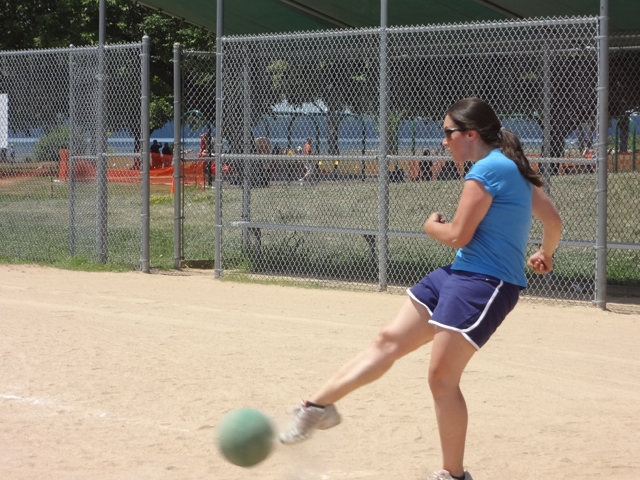
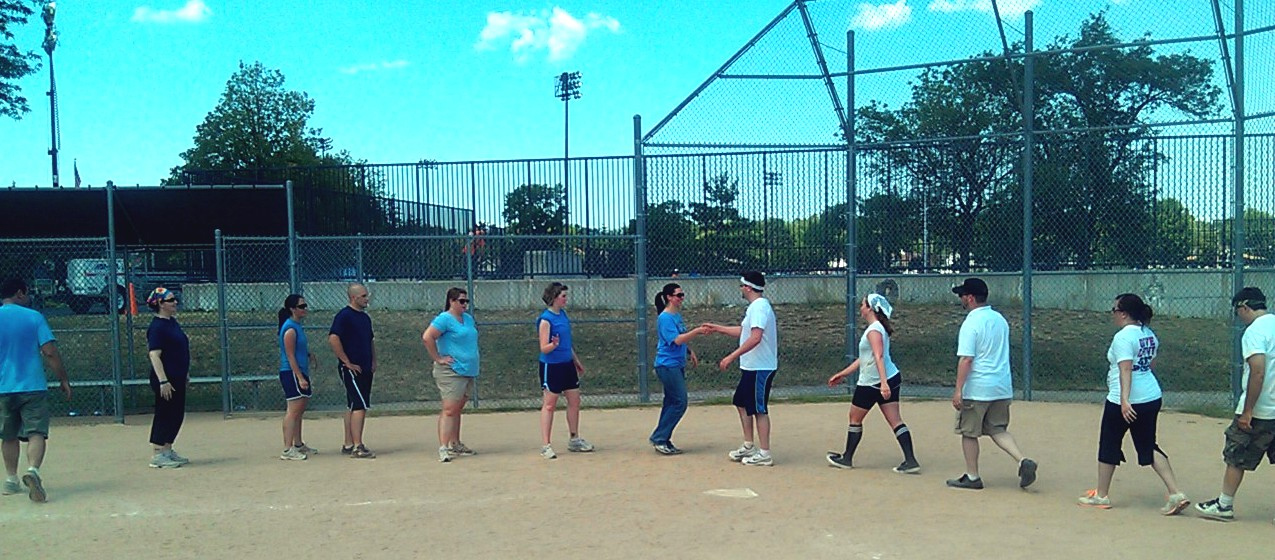
Photos from Syracuse Kickball #Tweetup2011!

On Saturday, July 16, 2011, Frank (@dagsly) and I (@deafgeoff) hosted a kickball tweetup at Onondaga Lake Park to celebrate the fifth anniversary of Twitter going public. Frank was the captain for “Team @Ev” and I was the captain for “Team @Biz,” and what ensued was an afternoon of nerdy fun, pseudo-athleticism, and delicious refreshments with new and old friends!

Mitch, who umpired the game, wrote a summary of the day’s events. It was a little ridiculous because most of us hadn’t played kickball since grade school, and the heat was rough, but we had fun. Team @Ev won fairly, 18-15, despite a controversial call in the bottom of the last inning. I threatened to go Ron Artest on Mitch, and he threw me out. (Not seriously.)

Most people brought refreshments, and we also enjoyed having cheerleaders in Sunny (she took most of the photos), Katie and “Little Man.” All in all, it was a great time.

Thank you to everyone who came to Syracuse Kickball #Tweetup2011:
Frank – @dagsly
Nicole – @nursebeaslee
Teri – @jivetalkinmama
Andrea – @YoDaCoolest
Tracy – @tracytilly
Mike – @FitSyracuse
Melissa – @ArmoryMassage
Geoff – @deafgeoff
Kevin – @syrdt
Jared – @jaredbrickman
Pat – @Pat_Gonzalez
Mel – @mellokittie
Sarah – @SarahTarq
Lorne – @zbdaddy
Ross – @rvstoltz
Alyssa – @AlyssaHenry
Mitch – @Mitch_M
Steve – @SteveBorek
Jen – @nonpareilscake
Sunny – @sunnyinsyracuse
Katie – @katiekrames
(If I missed someone, let me know!)

» See more Kickball #Tweetup2011 photos on Facebook!